


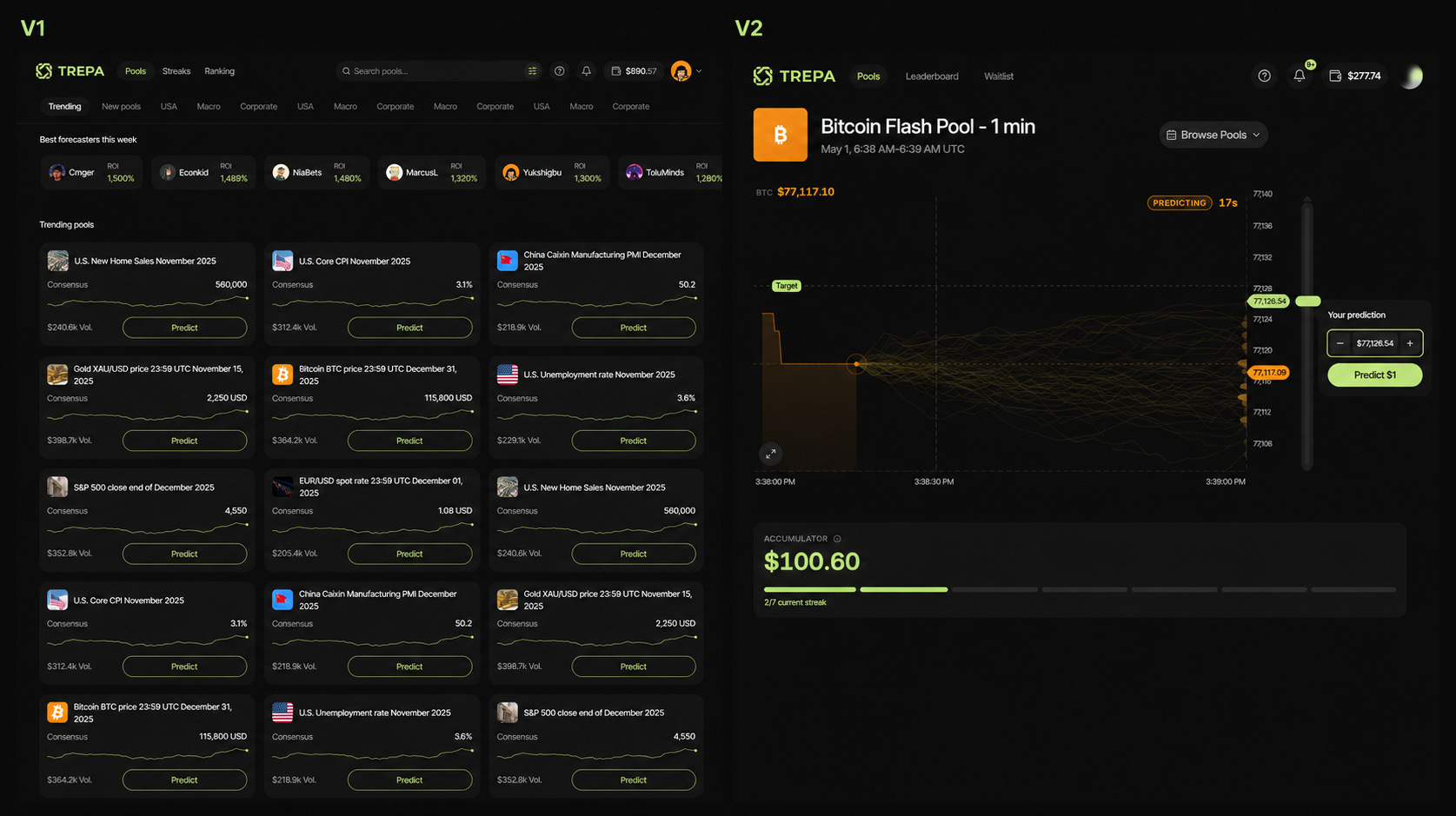
The most expensive thing a startup can do is get the audience wrong. We did, and V1 of Trepa is the receipt.
V1 was a forecasting platform with academic ambitions. Long horizons, macro metrics, the kind of framing that would be at home in a research brief. We thought we were building for the kind of person who reads Tetlock and runs simulations on their lunch break. Those people exist. They just were not going to use us.
Academic forecasters and finance professionals already have battle-tested tools. Established markets, real liquidity, decades of risk math, EV-driven habits formed in venues where the spreads are tight. If you are hunting for edge, you go where the order books are deep. You do not go to a crypto-native startup with a clever scoring formula and a small audience.
We brought the wrong audience to the wrong product at the wrong time. Three wrongs do not make a right.
The diagnosis
Two things broke the loop. Resolution windows were too long, so rounds returned no dopamine. We had also spent a lot of time finding a model that matched the trader mental model of expected return and risk-reward, and we now know that the audience that wanted that math was not the audience a parimutuel game was ever going to serve. The macro framing made every prediction feel high-stakes in a bad way, when what people actually wanted was a low-cost way to test their intuition and play again. The product had been built for a forecaster who wanted to feel smart. The audience that showed up wanted to feel something.
What V2 is
Flash Pools is the rebuild. The bottom line: $1 entry, 1 minute, 100x.
Players forecast BTC price. Thirty seconds to commit, thirty seconds to resolve. The closer half wins, the closest winners earn the most, and the next round starts immediately. Eventually there’ll be 24x60=1440 rounds every day. Everything that made V1 feel like a graduate seminar got cut. Everything that tightens the feedback loop got prioritized.
The core loop is engineered to be addictive in the right way. One minute is the right length: short enough that you always think “one more round,” long enough that the prediction feels like a real decision. The split into a forecast window and a resolution window creates natural tension and release. That structure is the same emotional architecture that makes the most engaging consumer products work.
Who it’s for
A short timeframe plus a gamified frame changes what the system is even for. Someone who shows up for a one-minute game is not bringing trader-grade expectations about expected value or Sharpe-ratio optimization. They should not be. The whole point of Flash Pools is that you can play without doing that math, and the math you would do at a real trading venue would tell you to play somewhere else anyway.
This is what V1 got wrong. We treated the absence of EV-driven framing as a gap to fill while it is actually the feature.
What we chose not to build
V2 is opinionated about its omissions.
Long time horizons. Anything longer than a minute reintroduces the problem we just solved. If you want to forecast next quarter’s inflation print, there are better products for that.
Conditional and parlay markets. Stacking probabilities into compound predictions is interesting, and it is also the fastest way to make a player open a calculator. We wanted players in the round, not in a spreadsheet.
A complex onboarding tutorial. The product has to teach itself in the first round, or it has lost. Anything that forces a player through more than a few seconds of explanation before their first prediction is a tax we refused to pay.
Heavy social mechanics at launch. Friend graphs, public profiles, follow features, in-app chat. All of it can come later. None of it is what makes the core loop work.
Skill is still in there
The reasonable critique is that a one-minute prediction game is just gambling with extra steps. We do not fully buy that.
Continuous scoring is the real differentiator. Binary prediction markets flatten the skill curve, because a miss by $1 and a miss by $1,000 produce the same outcome. Rewarding closeness means a calibrated forecaster can consistently outperform a coin flipper. That is what turns a gamble into a game.
We also opened API access so developers and quant-leaning players can programmatically participate. If you want to run a model, run one. If you want to test whether a small calibrated edge survives in a noisy short-horizon environment, do it.
There is a tension here worth naming. We just spent a section saying that Flash Pools is for players who do not want to do EV math, and now we are inviting the people who do nothing else. Both are true at the same time, and the design depends on it. The casual player does not need to think about expected value to enjoy a round. The quant who wants to is welcome. The first group is what makes the game alive. The second is what makes it deep. Neither needs the other to validate them, but the game is better with both in it.
The bottom line
$1 entry, 1 minute, 100x. Real BTC settlement. Continuous scoring that rewards closeness. That is the product we should have built first.
Docs at docs.trepa.io. Developer API at docs.trepa.io/developers. Early access launches in early May.
Best,
Trepa team