


We did not start with a mechanism. We started with one goal: reward precision, and nothing else. Then we went looking for a market structure that does that, and eliminated every option until one was left. The survivor was pari-mutuel over a continuous outcome, run at high frequency. Almost every expert will tell you pari-mutuel is the wrong foundation for a prediction market. They are right, almost always. I’ll lay out below the narrow case where they are wrong, and why we bet Trepa on it.
TL;DR: The structure we landed on has three famous weaknesses: you cannot see your payout when you commit, you cannot exit, and once you are in you can only watch it resolve. Our bet is that under two constraints, 1) continuous outcomes and 2) a sub-minute clock, those weaknesses become the product. The helpless watching turns into the most watchable moment in any market app, and existing trading-based platforms cannot copy it without tearing up their core structure.
What we were actually looking for
We wanted to reward numerical precision, the pure distance between what you predicted and what turned out to be true. Numerical, because so many events in the real world are actually not about Yes or No. We have never been about which side you picked but about how close you were.
Binary prediction markets reward the side. You buy yes or no, up or down, the event happens or it does not, but the center of gravity of your conviction earns nothing. Polymarket and Kalshi run this as an order book, a genuinely good machine for what it does. It just cannot measure closeness, because there is no closeness in a yes or no.
Leveraged directional products and spread betting reward side and magnitude together. You are paid more for being more right, but on an open-ended payoff, so the score is how hard you leaned rather than how close you landed.
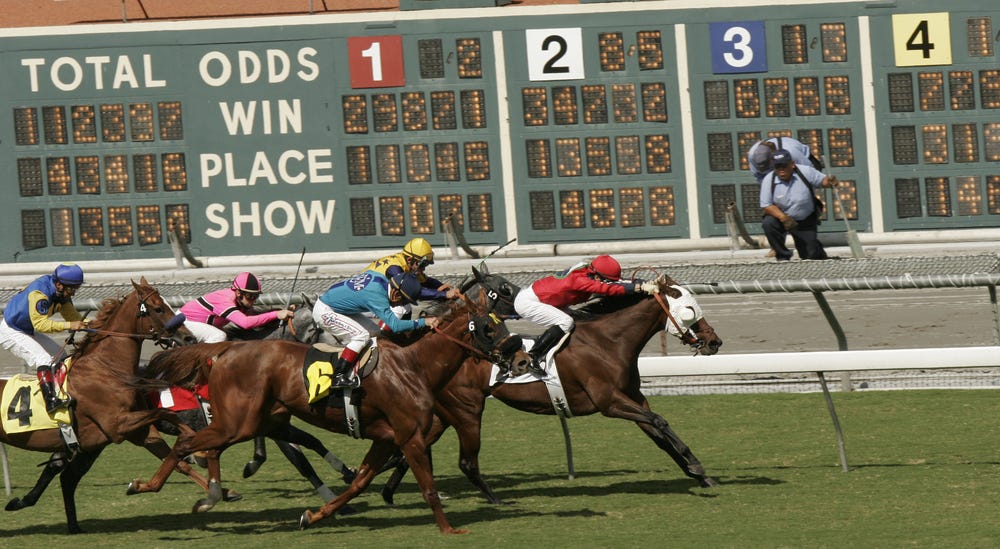
Traditional pari-mutuel rewards the correct discrete pick and nothing finer. Horse no. 6 wins or it does not. There is no “almost,” because the outcome space is a short list of names rather than a number line.
Three obvious candidates, all out for the same reason: they are built on discrete sides (picks) or open-ended magnitude, and neither can express “you were off by…”. We needed a reward that is a smooth function of distance to the truth, which takes two things at once. A continuous outcome to measure distance against, and a mechanism that pays by relative closeness rather than a fixed quote on a predefined claim. Only one mechanism does the second part. Pari-mutuel splits a shared pool among those who were right, in proportion to “something”. Typically, this is their stakes but put a continuous outcome under the pari-mutuel and what matters becomes how close they were. That is the unlock.
We even ruled out the slow version of our own answer. Continuous pari-mutuel over long horizons, predict where Bitcoin closes this quarter and wait three months, rewards precision in theory and is miserable in practice, for reasons we will get to. The survivor was continuous pari-mutuel at high frequency.
The case against the thing we landed on
Having chosen pari-mutuel on the merits, I have to be honest about its reputation.
In a pari-mutuel pool, everyone’s money goes into one pot, and when the outcome is known the pot is split among the people who were right, in proportion to what they put in. There is no fixed payout, you do not know your return when you commit, and you cannot trade out once you are in. An order book is the opposite on all three. You get a price the moment you buy, you have established mental models to weigh risk against reward, and you can sell at any point before the event resolves.
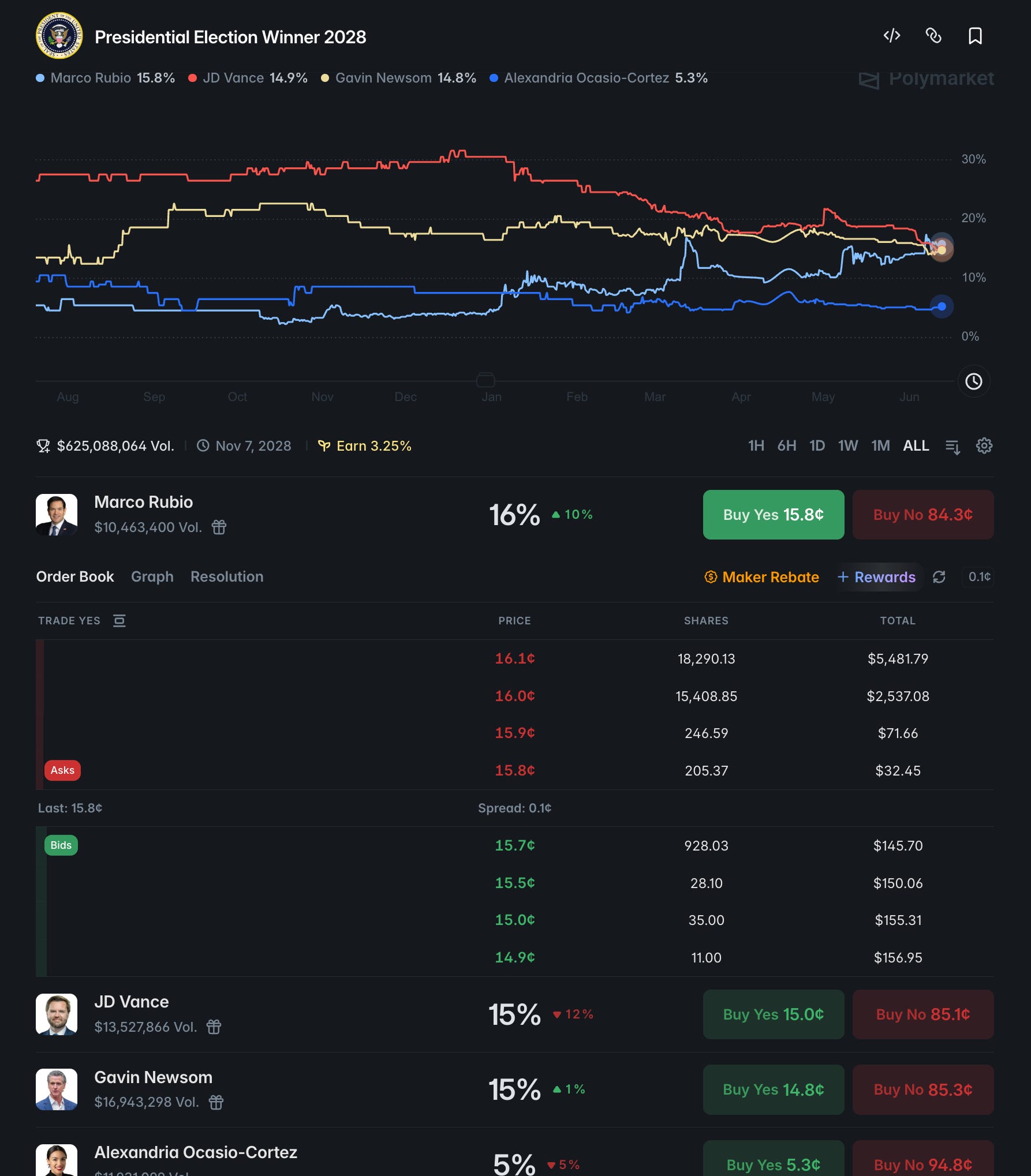
Against that, pari-mutuel looks primitive. You are flying blind on price. You cannot get out. You can only wait and watch. Every serious objection comes down to one of these three: no fixed payout at entry, no exit, no control.
The (semi-)anonymous actuary who writes the analytics blog Plus EV Analytics and whose models have guided over $100 million in betting positions, laid out the honest case for and against pari-mutuel. He calls one objection the elephant in the room. People would rather commit at a number they can see than at a return that is still forming, and they bristle when the multiplier on screen at the moment they commit is not the one their position finally pays. He concludes that if pari-mutuel struggles to reach a mainstream audience, this is overwhelmingly the reason.
So the textbook says never build a modern prediction market on pari-mutuel, and the textbook is correct, given what it imagines: discrete outcomes that resolve far in the future. An election. A rate decision. A yes or no that settles weeks from now. Under those conditions every weakness above bites hard, and an order book is probably better. We are not building that though. There are two things that make us different and those two things turn each weakness into an asset.
The first constraint: continuous outcomes
The first constraint we arrived at by working backward from precision. Stop asking which discrete thing will happen and start asking where a number will land.
Trepa rounds ask you to predict where a metric, currently BTC against USD, will land at a specific moment, with (multiple) decimal places of precision. You place your conviction on a single point on the line.
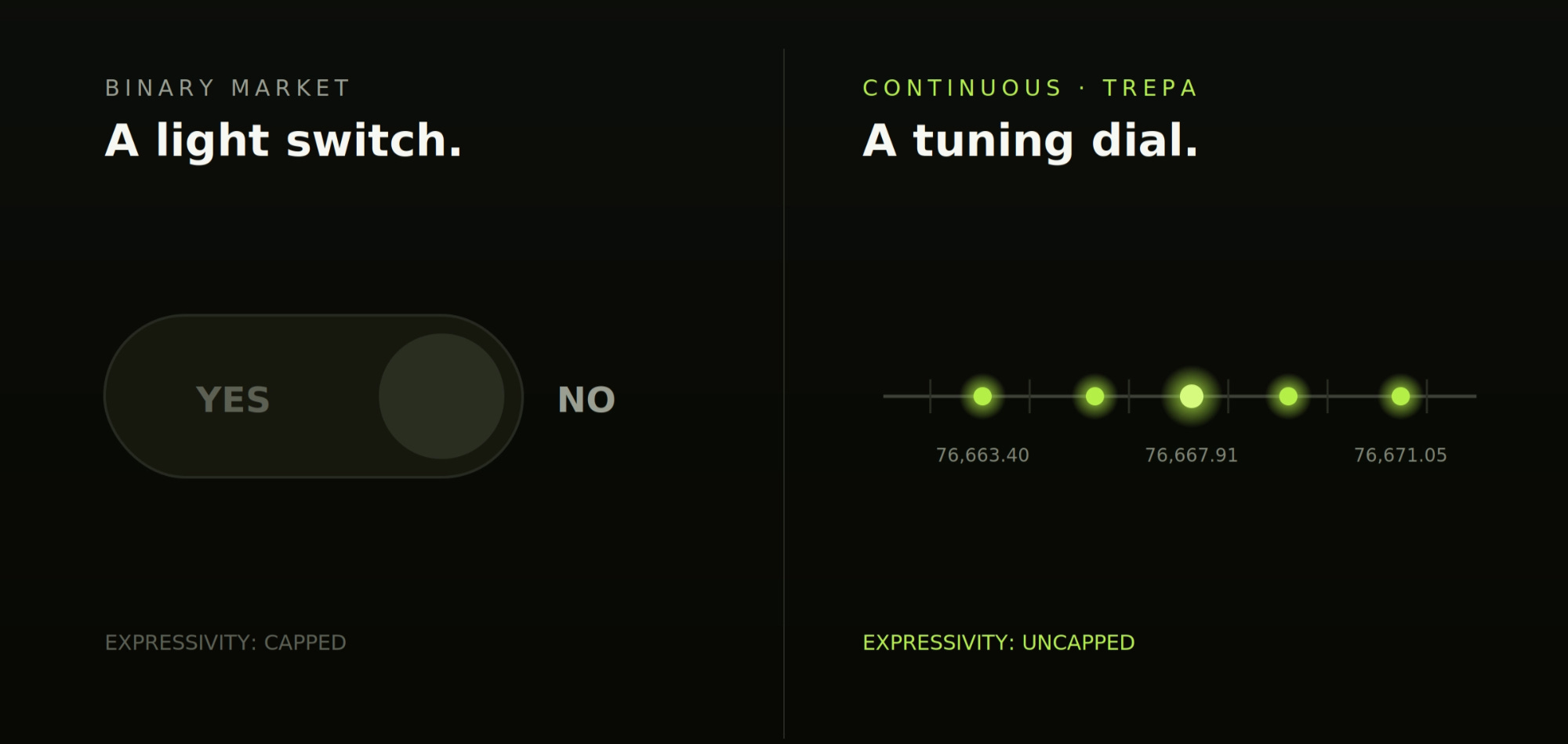
In a market built on outcome tokens, expressivity is capped. With two outcomes you can buy one side or the other, and the number of distinct things you can say is a function of how many outcomes the market offers. That number is small because someone defines each outcome in advance. The market intern sets the questions. You only answer them.
Continuous outcomes remove the cap. There is no list to pick from. The outcome space is the number line, your prediction is any point on it, and the distance between your point and the truth is what gets measured and rewarded. That is your precision, and it is the only thing being scored.
A pari-mutuel pool over a continuous outcome is the only structure where your reward is a function of how close you were and nothing else, measured against where everyone else landed. No side to take, no leverage to apply. The main point is: closeness is the entire game, and no other mechanism makes closeness the entire game.
This is why an order book was never an option for us, however good it is at its own job. To use one we would have to predefine the outcomes, and the moment we did that we would be back to discrete picks with the precision gone. If you want to reward closeness exclusively, you cannot use a book [1].
The second constraint: high frequency
Continuous outcomes make scoring precision possible and fix expressivity. But they do nothing for the three classic complaints of pari-mutuel. For that you need the second constraint, and it is easily missed: make the rounds short, under a minute. This is where the contrarian bet lives, because short rounds are what actually converts each weakness into the experience.
A payout that updates live, lurching up and down as the price moves, is the best thing about the product rather than a defect to apologize for, as long as it feels like watching a show. Your read on where the price is heading stays fully yours, and you can sharpen it with order flow, microstructure, AI-assistance, any edge you can find. What you give up is narrow: locking your exact multiplier before you commit, the way an order book quotes you a fixed price up front. The forecasting edge is untouched. The moving multiplier (payout) you get instead is the entertainment, not the cost.
Then the other two, no exit and no control, which are really one thing. Once predictions lock, you cannot get out and you cannot adjust. You have no move to make. Across weeks that would be genuine helplessness, the worst kind of waiting. But if you compress it into a sub-minute window with the price moving live, the helplessness inverts into what makes a horse race thrilling to watch. You have already placed everything. Now you can only lean forward and root for the number and this makes the feeling so big.
The weakness was the feature
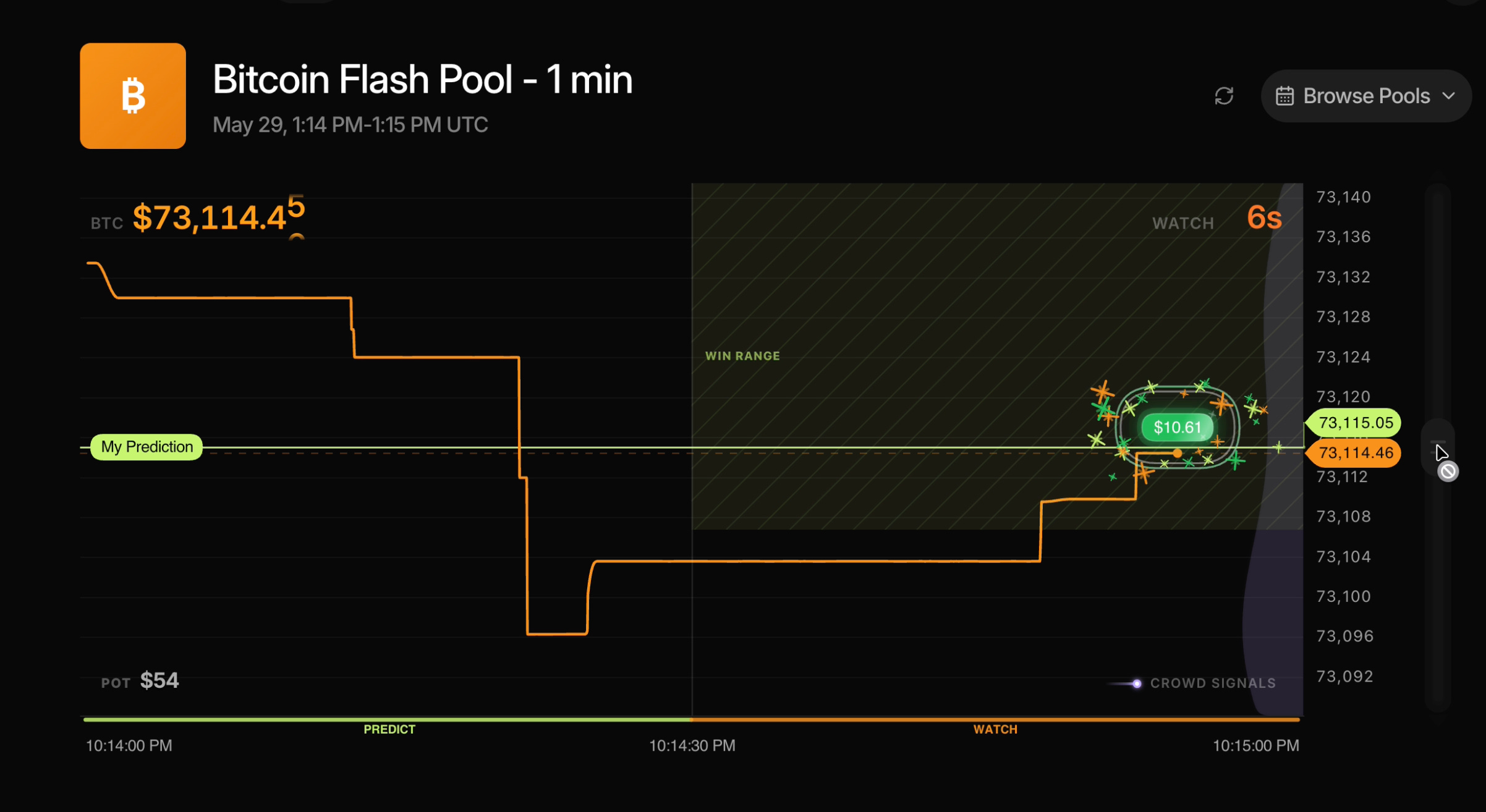
This is the whole argument in one screen. Your prediction sits locked as a bright line, marked “My Prediction” at 73,115.05. The live Bitcoin price moves across the chart second by second. Riding alongside it is a single number in a green bubble, $10.61, what your position would pay right now if the current Bitcoin price was the final outcome.
Once predictions lock, nothing about anyone’s position can change. Everyone is in. Nobody can hedge, add, or pull out. Every variable is frozen except one. The live price.
In an order book this would be a dead, helpless period. In Trepa it is the show. Because the payout is not fixed and the pool is shared, that number in the green bubble is alive. As the price drifts toward your prediction it climbs and you feel the dopamine. As it pulls toward where the crowd clustered, it compresses and your stomach drops. The same live price does this to everyone at once, in different directions, depending on where each person planted their conviction. You are on the edge of your seat rooting for a number.
That is only possible because of the exact properties the textbook warned against. A fixed payout would set your return the moment you entered and the watch would be inert. The ability to trade out would dissolve the tension, which exists only while you are committed and unable to act. Every supposed weakness is load-bearing for the one experience nobody else can offer. A round runs under a minute because that is the rhythm of attention a generation raised on short video already lives by. The clock is set by the show, and the show is the whole point.
Why this wins, and how it could lose
Neither constraint works alone. Continuous outcomes over long horizons leave you holding an uncertain position for weeks, which is genuinely bad. High frequency over discrete outcomes is just a fast coin flip. The intersection does the work. Pari-mutuel needs the continuous outcome to reward precision, and it needs the short window to turn its own weaknesses into an entertainment.
I will be just as clear about how this fails. If Trepa loses, it will be because a precise prediction takes real cognitive effort, and the promise of a quick multiplier plus a thrilling watch phase was not enough to make people pay that effort, round after round. That is the bet in one sentence. We think the show is worth the thinking. Also, we believe that a diverse audience will enjoy placing predictions on our app: from vibe-predictors, microstructure-sharps, AI-ensemble masters, to chart-reading sorcerers.
To summarize, we went looking for a structure that rewards precision exclusively, eliminated everything else, and found the lone survivor came with famous flaws. The thesis is that high frequency and a careful interface convert those flaws into the most watchable moment in markets. As far as we can tell, we are the only ones standing in this corner.
If you think there is a fourth weakness we have not priced in, I would like to hear it. We love pushback that makes our product stronger.
A closing note on why precision, of all things. The fixation predates the company. The founding team is German, and exactness is a virtue the culture cares about, in engineering, in how you speak, in ordinary daily life. Building a product that pays out for being precise, and nothing else, felt like the obvious thing to make, rather than a market-design exercise.
Footnotes
There is a known hybrid called a dynamic pari-mutuel market (DPM), introduced by David Pennock in 2004, which crosses a pari-mutuel pool with a continuous double auction so participants can sell before resolution. It is worth addressing because the name sounds like what we built, yet it solves a different problem. DPM is defined over discrete, mutually exclusive outcomes, the “pays out if outcome i occurs” form, and “dynamic” refers to continuous trading over time rather than a continuous outcome space. Because you can sell as the pool grows, current DPM implementations that we are aware of reward entering an outcome early and riding later inflows, which can pay off regardless of whether that outcome is correct. That incentivizes aping into a side for momentum rather than being accurate.